Garage door cable and roller replacement in North Jersey and Central Jersey
Frayed lift cables, worn rollers and drifting tracks found and corrected before they drop a door or bend a panel.
What this covers
Cables and rollers are the moving parts of the door system, and they are the parts that turn a slowly failing door into a suddenly stuck one. A frayed cable shows itself as a strand or two standing proud of the wrap before it parts, and a tired roller shows itself as a shudder in the same place on every cycle. Both are replaced in a single visit, with the tracks cleaned, lubricated and checked for alignment while the door is apart. The work is done at your property by appointment at any hour, across Bergen, Essex, Hudson, Middlesex, Morris, Passaic, Somerset and Union counties.
- Frayed and parted lift cables on torsion and extension systems
- Cable drums re seated and re spooled to equal wraps
- Nylon and steel roller replacement across all sections
- Hinge and stem checks while the door is apart
- Track cleaning, lubrication and realignment
- Bent track sections and loose track fasteners corrected
What the visit covers, layer by layer
The moving parts are checked in the order the door carries load: cable, roller, track, then the drums and shaft behind them.
Cables are always judged together with the springs, because a cable can only be read against the tension it runs under.
- 01 · Lift cables Every strand followed along its length, from the bottom fixtures to the drums A cable that parts under load lets one side of the door fall, bends panels and leaves the door wedged in the opening
- 02 · Rollers and hinges Each roller spun for flat spots and play, every hinge checked for wear Flat or seized rollers shudder and grind, and the vibration works hinge fasteners loose until the door rattles and racks
- 03 · Tracks Both tracks cleaned, lubricant kept off the rails, then plumbed and run for kinks A door forced along a kinked track wears its rollers flat and can jump the track, which turns a small repair into a panel job
- 04 · Drums, shaft and balance Cable wraps set equal at both drums, shaft and bearings checked, balance confirmed at half travel Unequal wraps lift one side before the other and rack the door, and a worn bearing lets the whole system run out of true
What people want to know before booking
A cable hanging slack beside the drum
A cable that has slipped its drum leaves a loop of wire beside the drum and a door that sits crooked in the opening. It usually follows an obstruction under the door, a hard stop mid cycle or a lift by hand from one side only. The door should be left where it is and the opener left unplugged, because finishing that cycle winds the slack the wrong way and bends the bottom panel.
The shudder in the same place on every run
A roller with a flat spot, a cracked nylon wheel or a seized bearing announces itself at the same point in the travel every time, because the same wheel crosses the same curve of track each cycle. Left alone it wears the track at that spot, and the repair grows from a set of rollers into a track section.
One side of the door runs ahead of the other
A door that racks in its opening has one side lifting before the other, which comes from unequal cable wraps, a stretched cable or a spring system out of step. Running it that way grinds the rollers and hinges at the stiles and can pull the door out of the track. The cables and drums are checked together, because the fault is shared between them.
What quiet travel is worth
A door in good condition runs on fresh rollers almost silently, and you can test that today by standing inside the garage and running the door. Grinding, popping and squealing are the audible list of what is worn, and they are cheapest to quiet when the parts are replaced before they deform the tracks around them.
What the lift cables do and how they fail
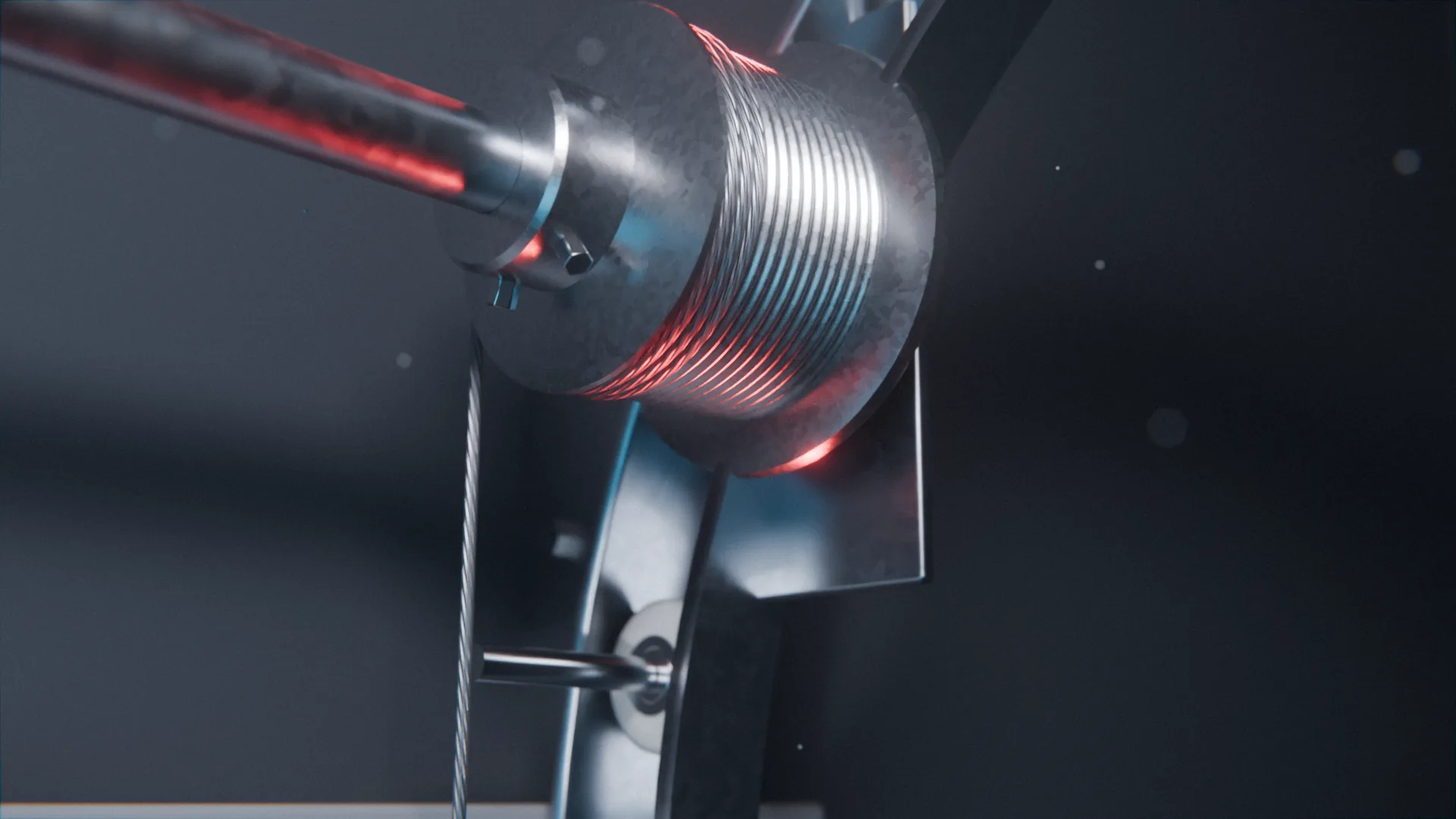
The cables are the last link between the springs and the door. They wrap around drums at the ends of the torsion shaft and fix to the bottom corners of the door, and they carry the door's full weight on every cycle. Their condition is checked whenever the springs are, because the two fail in step.
A cable frays strand by strand where it runs over a worn drum groove or a corroded fitting, and the first signs are a broken strand standing proud or a birdcage of wires where the cable enters a fixture. A cable in that state is replaced rather than run, because the remaining strands are all that carries the load of one whole side of the door.
A parted cable is the loudest failure on the list short of a spring. One side of the door drops, the door wedges itself in the opening at an angle, and the opener cannot be trusted to move it. The door is brought level under manual control, the cable is replaced and the wraps are set equal before the system is run again.
Rollers: nylon or steel
Rollers are the door's wheels, riding in the tracks through hinges fixed to every section. Nylon rollers run quietly and wear out as a consumable, and steel rollers outlast them and announce themselves the whole way. Either kind fails the same way in the end: the bearing dries, the wheel flats or cracks, and the stem wears where it seats in the hinge.
A roller replacement visit swaps every roller in the set rather than the two that are loudest, because they were installed together and they are wearing together. The hinges are checked in the same pass, since a worn stem and a worn hinge bore produce the same symptom, and both are addressed while the door is apart.
The difference after the work is audible from the driveway. A door on fresh rollers and clean tracks runs without the shudder at the curve of the track, and the opener stops straining against the friction it had been fighting. It is one of the repairs where the improvement is immediate and testable before the technician leaves.
Tracks: clean, lubricate, align
The tracks are the rails the rollers ride, and they collect what the door carries in: grit from the driveway, dust from the road and the metal wear of the rollers themselves. A track that is dirty drags, a track that is dry squeals, and a track that has been nudged by a car bumper or a snow shovel kinks inward at exactly the height of a roller.
Cleaning and lubrication are done to the parts that need it and nowhere else. Tracks are wiped rather than oiled, because oil in a track holds grit, and the lubricant goes on the rollers, hinges and stems instead. A lubricant made for garage door hardware stays where it is put, while the all purpose penetrant under the sink migrates and gathers dust.
Alignment is checked with the track plumbed and the fasteners along its run tightened. A section that has been bent is replaced rather than hammered flat, because a hammered track has a hard spot the rollers find on every cycle, and the door will report it in the same sound you called about.
How the visit runs
The door is brought to a workable position by hand with the opener disengaged, secured in place and made safe before anything is loosened. Cables are never worked while the springs hold tension on them, so the spring state is read first and the order of the work follows from it.
Cables are replaced at the drum and the bottom fixture, rewound onto the drums in equal wraps and verified by turning the system by hand through a full cycle before the opener is reconnected. Rollers are swapped one hinge at a time, and the door is run by hand between sets so that anything binding shows itself while the cause is still in reach.
The visit ends with the balance checked at half travel, the door run through full cycles by hand and by opener, and the track runs wiped down. The parts that came off leave with the technician, and the written estimate you approved is the one that appears on the invoice.
When a cable problem points higher up the system
A cable that frays at the drum is usually telling you about the drum or the shaft rather than the cable: a groove worn wide, a drum that has slipped on its shaft or a bearing that has let the cable walk off its line. Replacing the cable without reading the drum is how the same visit gets booked twice.
A cable that comes off its drum without breaking is usually a balance question. A door out of balance slams or drifts, and the slack in the cable at the wrong end of the travel is what lets it jump. The springs are checked and the balance is set before the cable is blamed for a fault it was reporting.
This is the overlap between the services on this site: cables, springs and tracks are one load path, and a technician who reads them together finds the part that is failing rather than the part that made the noise. Most visits combine a cable or roller replacement with a balance check for exactly that reason.
Frequently asked questions
Question 1: How much does cable and roller replacement cost?
No price is published on the site, because the job differs by door size, roller type and whether a track section needs correcting. A written estimate comes before work begins, listing the parts and the labor separately. If the inspection turns up a spring or drum problem that explains the wear, that is quoted before anything further is touched.
Question 2: Can I run the door with a frayed cable?
No. The cable on each side carries the full weight of that side of the door, and the strands that remain behind a fray are all that stands between the door and a drop. A frayed cable is a part on its way out with a date unknown, and running the door on it risks a bent panel, a wedged door and a repair that costs several times the cable.
Question 3: Nylon or steel rollers, which are better?
Nylon rollers run quietly and are the usual choice for a door under a bedroom, and they are replaced as they wear the way tires are. Steel rollers last longer and are louder, which suits a detached garage or a commercial door. Both are fitted in matched sets, and the visit ends with the same balance and reversal checks either way.
Question 4: How often should the door be lubricated?
A door in daily use does well with the rollers, hinges and stems lubricated a couple of times a year, and with the tracks wiped rather than oiled. The lubricant matters: a product made for garage door hardware stays on the parts, while a general penetrant migrates and gathers grit. If the door has started to squeal between visits, that is a wear symptom to have read rather than a schedule to tighten.
Question 5: The cable came off the drum but is not broken. What happened?
A cable jumps its drum when slack appears at the wrong moment, which follows an obstruction under the door, a hard stop mid cycle or lifting the door by hand from one side. It can usually be re seated rather than replaced, but the wraps are then set equal and the balance is checked, because the slack had a source. A door whose cable comes off twice in a season has a balance or spring question under it.
Question 6: Do you serve my town?
Cable and roller work is offered across Bergen, Essex, Hudson, Middlesex, Morris, Passaic, Somerset and Union counties, done at your garage with no shop visit and nothing to drop off. Appointments are taken at any hour, and a door wedged crooked in its opening is treated as urgent. Send a photo of the drum or the roller line and the visit is planned around the likely parts.
Question 7: Why replace all the rollers when only two are noisy?
The rollers on a door were installed in one set and have run the same number of cycles, so the quiet ones are at the same stage of wear as the loud ones. Replacing the set costs little more than the two and saves the second visit. The exception is a door with a single damaged roller from a specific knock, where the diagnosis is one roller and the cause of the knock.
Where we do this
We cover eight counties across North Jersey. All services are performed at your home or business.
- Bergen County70towns
- Essex County23towns
- Hudson County12towns
- Middlesex County25towns
- Morris County39towns
- Passaic County16towns
- Somerset County22towns
- Union County21towns
Towns we cover
- Hackensack, NJ
- Paramus, NJ
- Fort Lee, NJ
- Newark, NJ
- Montclair, NJ
- Livingston, NJ
- Jersey City, NJ
- Hoboken, NJ
- Bayonne, NJ
- Edison, NJ
- Woodbridge, NJ
- New Brunswick, NJ
- Morristown, NJ
- Parsippany-Troy Hills, NJ
- Madison, NJ
- Paterson, NJ
- Clifton, NJ
- Wayne, NJ
- Bridgewater, NJ
- Basking Ridge, NJ
- Somerville, NJ
- Elizabeth, NJ
- Summit, NJ
- Cranford, NJ