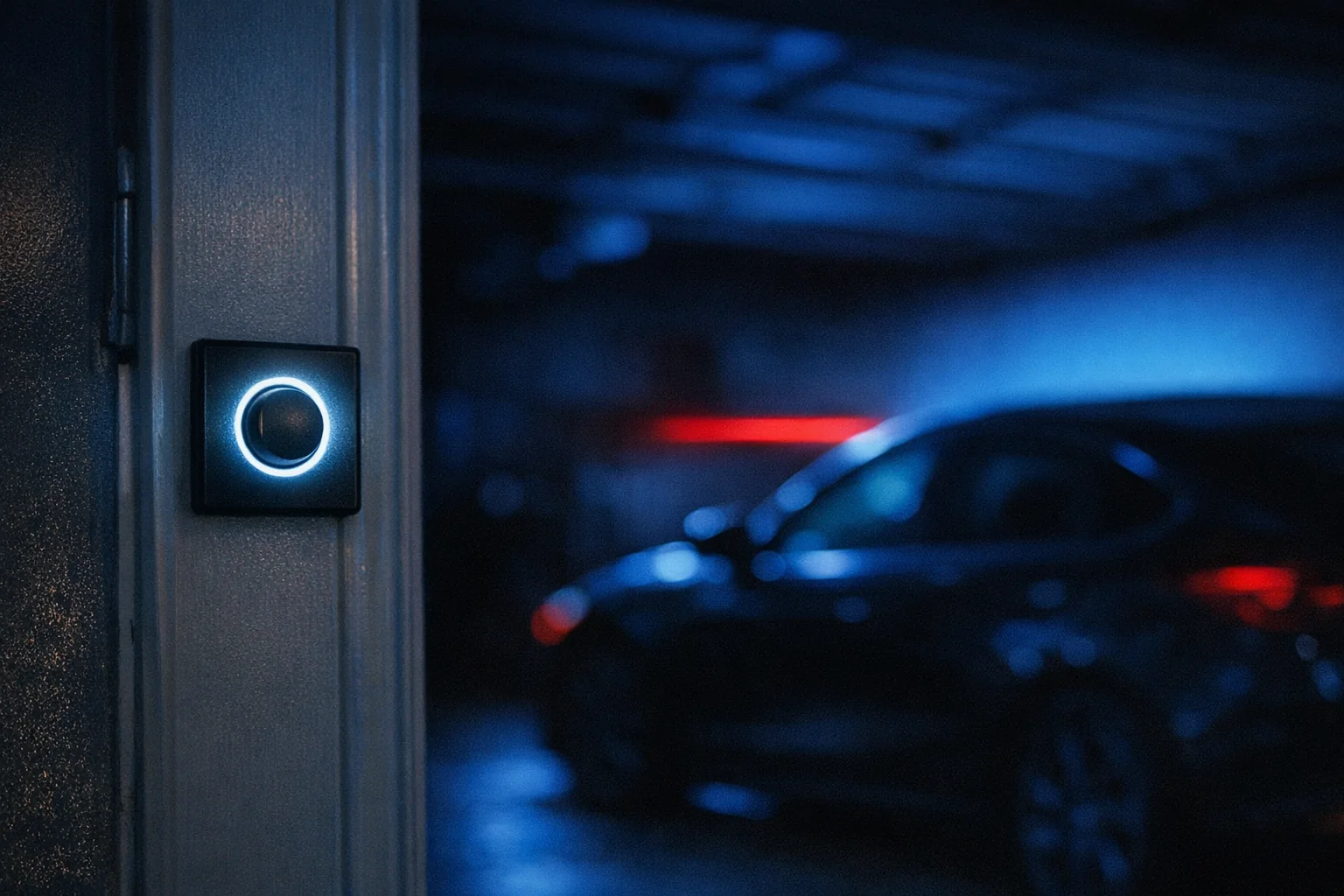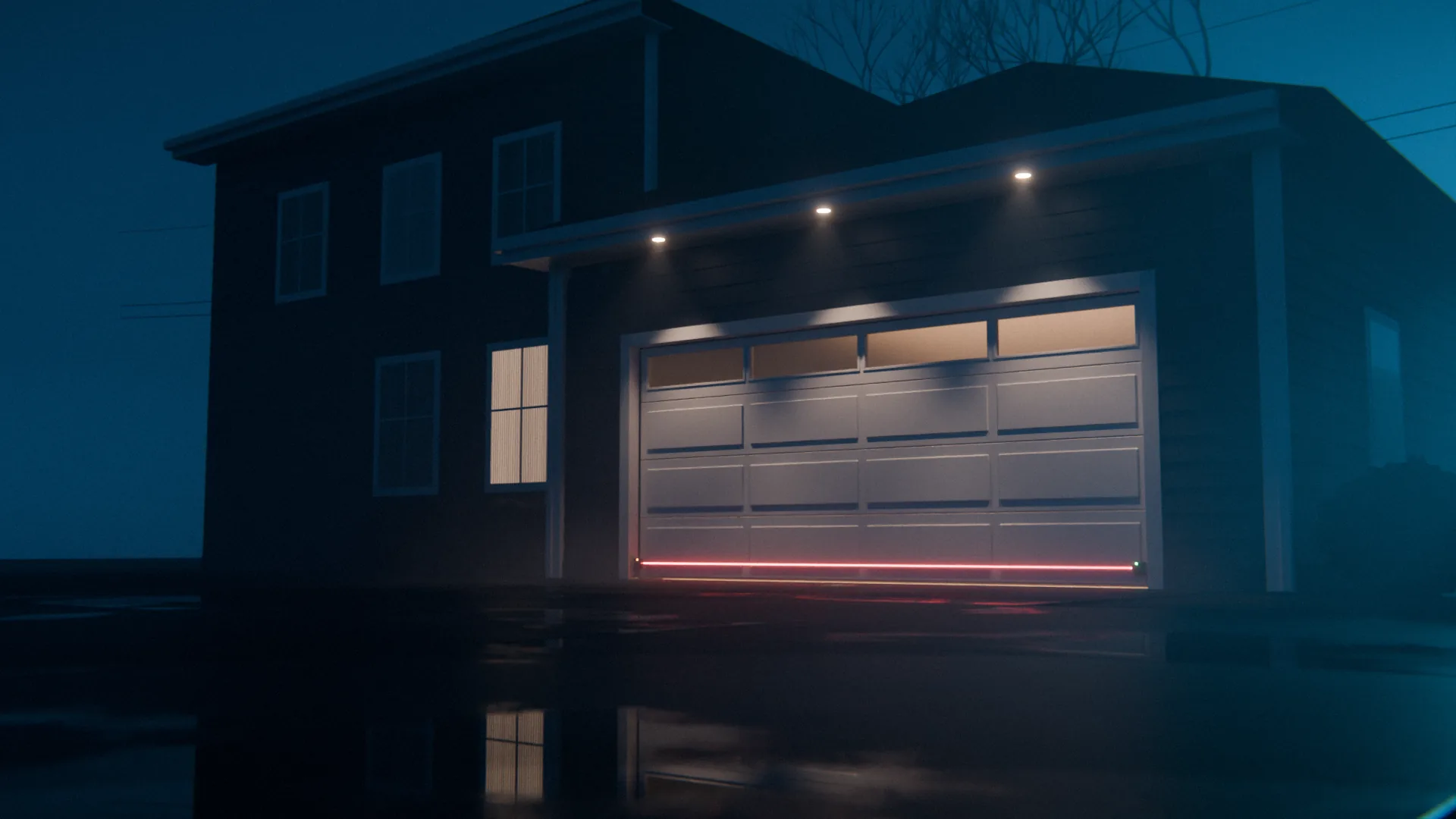
The pattern has a rhythm to it. The door works all day. Then, in the evening, it starts to close, stops, and runs back up with the opener light flashing. Some houses only have the problem at certain hours; some have it every night. Either way the opener is usually innocent, and the sensors are usually not.
Federal law has required safety reversal on residential openers for decades, and the photo eyes are half of that system. Understanding what they do explains almost every will not close call we take.
What the photo eyes are doing
Two small sensors sit a few inches off the floor on either side of the opening. One sends an invisible beam across the doorway; the other receives it. If anything breaks the beam while the door is closing, the opener reverses the door immediately. That is the point of them: a child, a dog or a bicycle under a descending door trips the beam instead of taking the weight.
The system is deliberately nervous. If the receiver cannot confirm a clean beam, it assumes something is in the way and refuses to close the door. It cannot tell the difference between a toddler and a misaligned bracket, so it treats both the same way.
What fools them
- A bumped bracket. Brooms, shovels and car bumpers clip the sensors, which sit exactly at ankle height, and a small twist is enough.
- Dirt and cobwebs on a lens. A film of dust scatters the beam until the receiver reads it as broken.
- Low sun. When the sun sits low in a west facing opening, direct sunlight into the receiver drowns the infrared signal. This is why the fault keeps to certain hours.
- Wiring. A staple through the low voltage wire, a wire touched by garage wall moisture, or a connection at the opener that has worked loose.
- A warped track or sagging jamb on an older opening, which has slowly carried the brackets out of alignment over months.
The two checks a homeowner can make
First, look at the small lights on the sensors. A steady light on each side means the beam is being made; a flickering or dark light means it is not. Some models use a green light on the sending eye and an amber or red light on the receiving eye, and the meaning is in the opener manual.
Second, check that nothing is across the beam, including the cobweb on the lens, and that both brackets look square to the wall. If a sensor has clearly been knocked, gently realigning it by hand often restores the light. That is the extent of the do it yourself work. Everything past that belongs to a meter and a proper reverse test.
What not to do matters more here than anywhere else on a garage door. Nothing that closes the door by defeating the sensors is a fix. Taping the buttons, jumping the wiring or holding the wall button down teaches the household to run the door with its safety system off, and the one time something is under the door, the system that should stop it has been switched off by the people it was installed to protect.
How a technician fixes it properly
The visit starts with the opener's own report. Most openers flash the diagnostic light in a countable pattern, and the number of flashes names the fault the safety board found, which is faster than guessing.
From there: the brackets are straightened and remounted square, the lenses are cleaned, the wiring is checked back to the opener and repaired where a staple or a nick has found it, and the sensors are aligned to each other with both indicator lights burning steady. Then the door is closed and opened on full cycles, and the auto reverse is tested twice, once by breaking the beam and once with a solid object laid under the door.
If the sensors and wiring are clean and the door still refuses, the diagnosis moves to the opener board and the force settings, which is the smaller share of these calls. That is the order, hardware before electronics, and it is why sensor faults are usually a small job.
When to call us
Call when the door reverses without a reason you can see, when the sensor lights will not come steady, or when the fault follows the time of day, which is the signature of sun into a west facing opening. Send a photograph of the sensors and the opener light if you can. All work is performed at your home or business across Bergen, Essex, Hudson, Middlesex, Morris, Passaic, Somerset and Union counties, and the estimate is written before any work starts.
Frequently asked questions
Question 1: Why does my garage door close in the morning but not at night?
Low sun across a west facing opening shines directly into the receiving sensor and drowns its infrared beam, so the opener reads the beam as broken. The fix is proper alignment and, where the opening allows, a small shield or shade over the eye.
Question 2: Can I just bypass the sensors to close the door?
No. The photo eyes are a required safety device, and every way around them leaves the household running the door with its only moving protection off. Holding the wall button to force a close is for a one time emergency, not a habit.
Question 3: What do the flashing lights on the opener mean?
On most openers the diagnostic light flashes in a countable pattern, and the number of flashes names the fault. Count them before you call; the pattern usually ends the diagnosis over the phone.
Question 4: How high should garage door sensors be mounted?
A few inches off the floor, low enough to catch a child or a pet but high enough to stay out of standing water and the snow brush. Both eyes must sit at the same height, square to each other.
Question 5: Do sensors wear out?
They can, and sun exposure hardens the plastic and fades the lens over the years. But most sensor faults are alignment, wiring or dirt, so the sensors are tested before they are replaced.
Question 6: My door reverses and the opener light flashes. Is it the opener?
Usually not. The flash is the safety board reporting what stopped the close, and in most cases that is the beam at the floor. The hardware is checked before the opener is blamed.