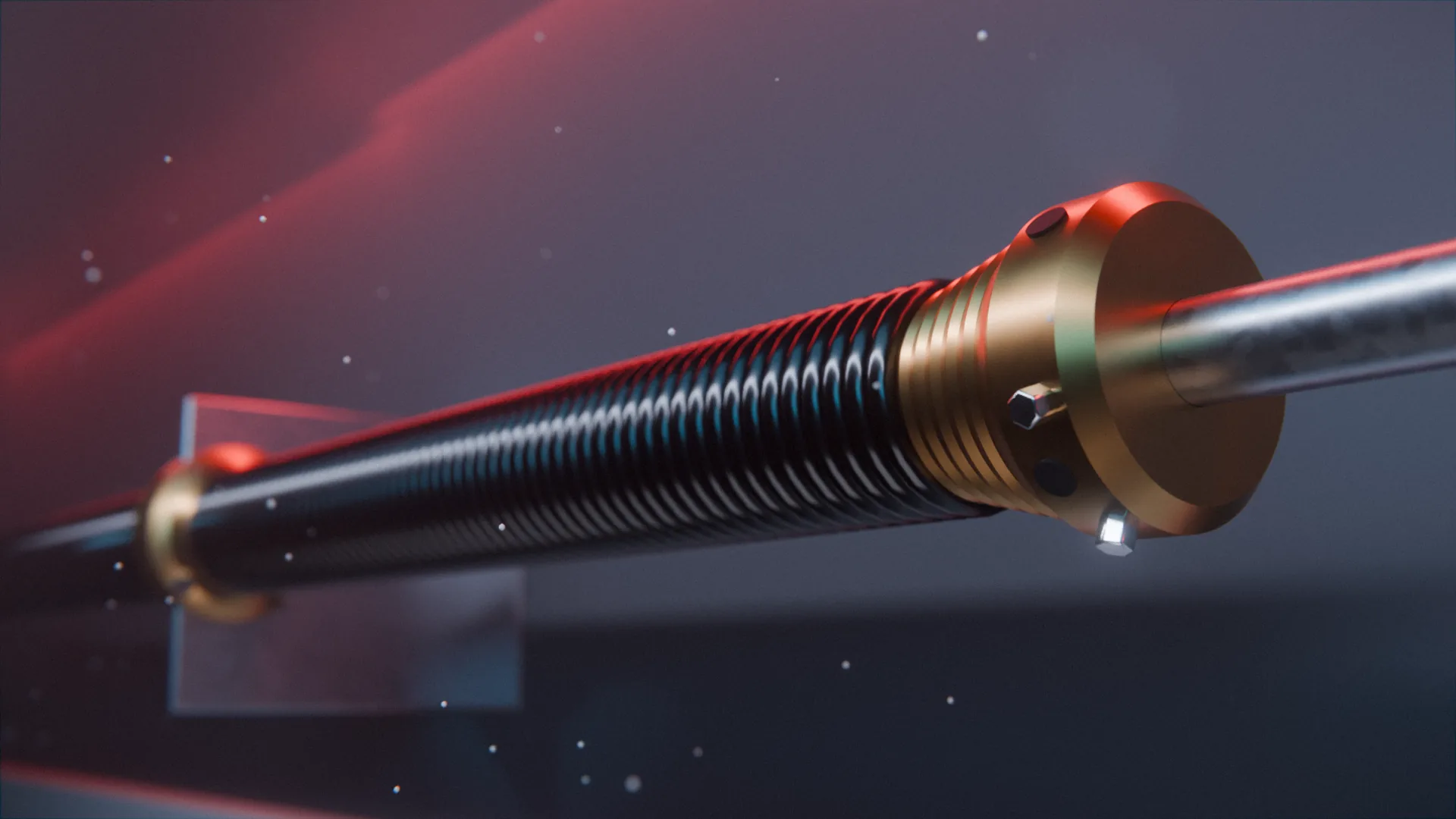
The quickest way to know which system you have is to look at the wall above the closed door, inside the garage. A long steel shaft running the width of the opening, with one or two coiled springs on it, means torsion. Two stretched springs running parallel to the horizontal tracks on either side of the door mean extension. Both systems do the same job: they store the energy that lifts the door, so the opener never has to lift the door's weight by itself.
Torsion springs
A torsion spring is a coil of oil tempered steel mounted on a shaft across the header above the door. It is wound up with winding bars, and the torque it holds is transferred to the door through cable drums at each end of the shaft. As the door opens, the spring unwinds in a controlled way; as it closes, it winds back up.
Torsion is what most modern residential doors carry, and for good reasons. The spring sits over the door rather than beside it, so the hardware stays inside the tracks. The movement is rotation rather than stretch, which runs smoother and quieter. And the counterbalance is easier to fine tune, because the turns on the winding cone are counted rather than guessed.
On heavier doors, a wide two car or three car opening, an insulated door, or a door with a heavy wind package, the shaft often carries two springs instead of one. That is not redundancy for its own sake: two springs share the load and let a heavy door be balanced without one enormous coil.
Extension springs
Extension springs are long, narrower springs that run along the horizontal tracks on each side of the door. They stretch when the door opens and contract when it closes, and they connect to the door through lift cables and pulleys. Older homes, lighter single car doors and some builder grade installations still carry them.
They do the same job as torsion, but they do it in tension rather than in torque, and that difference shapes everything about how they fail and how they are serviced. A stretched spring holds its energy along its length. When one breaks, the spring itself becomes a whipping hazard along the track, which is why extension systems are supposed to carry a containment cable through the center of each spring, a thin cable that catches the pieces if the spring lets go.
Many older extension installations have no containment cables, either because they were never fitted or because the safety cables were removed at some point. If you have extension springs and cannot see a thin cable running through the coils, that is worth fixing regardless of the springs' age.
How each system fails
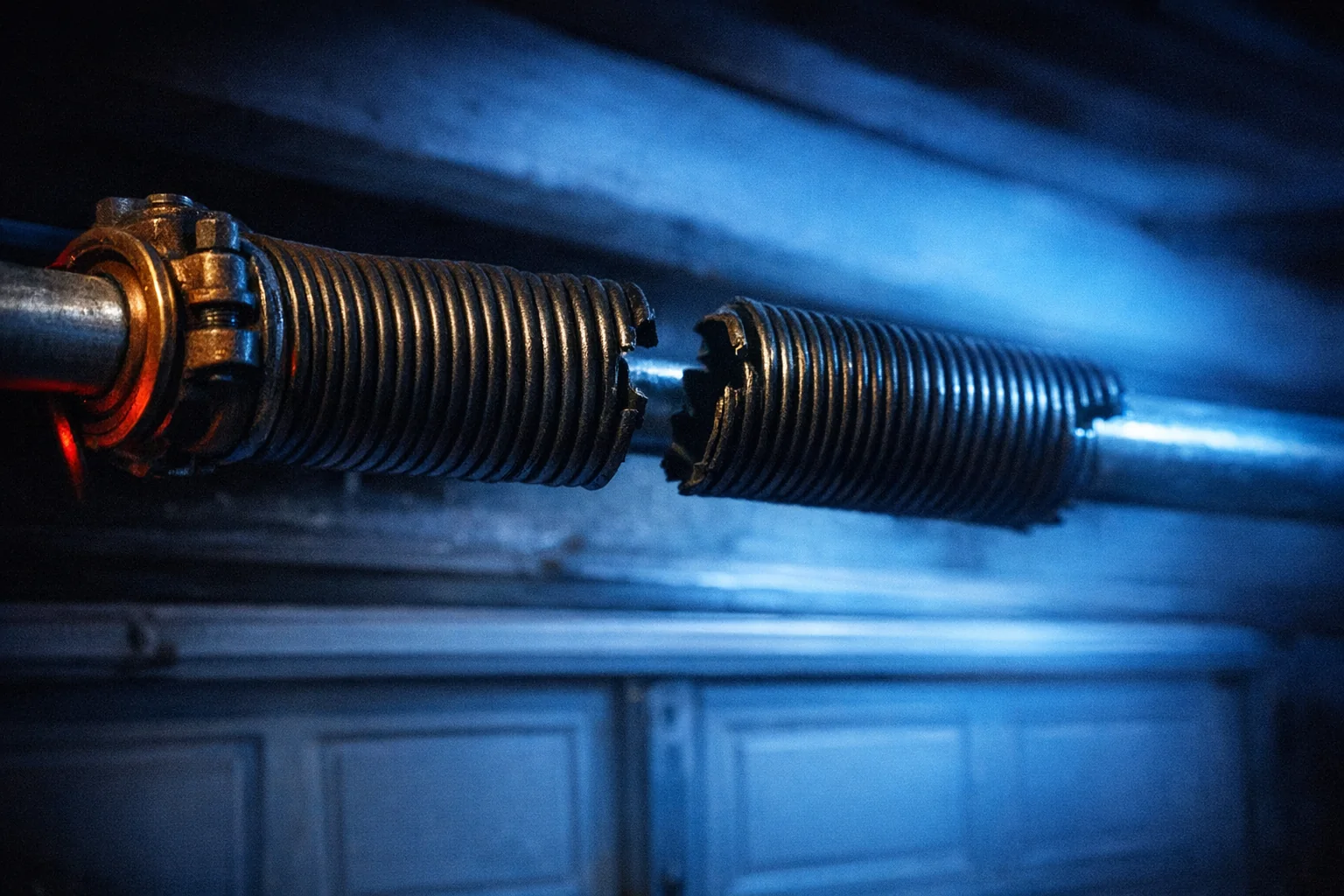
A torsion spring usually fails at the point where the coil is wound tightest, and it fails dramatically: a bang, a visible two inch gap in the coil, and a door the opener cannot lift. Before that final break, the warning signs are a door that closes harder than it should, and rust or paint cracking along the coil where the metal has been worked.
Extension springs fail the same way in principle, at the end of their cycle life, but the symptoms read differently. The door may lift crooked when one side lets go, the cables go slack on one side, and the broken spring's coils scatter along the track if there is no containment cable. Extension systems also wear their pulleys and lift cables faster, because those parts do the guiding that a torsion drum does.
Why the replacement method differs
Torsion replacement is controlled torque work. The door is secured in the opening, the old springs are unwound turn by turn with winding bars seated in the cone, and the new pair is wound to a counted number of turns calculated from the door's height, weight and track radius. There is no guessing, and the balance is verified with the door disconnected and lifted by hand to mid travel.
Extension replacement is tension work at full stretch. The spring is released from its fitting with the door in a position that unloads it, which takes care in itself, and the new spring and its containment cable are fitted and adjusted so both sides stretch evenly. The adjustment is checked with the door running, because an unbalanced extension system pulls the door sideways in the opening.
In both cases, both springs are replaced even when only one has broken. Springs age at the same rate, and mixing a new spring with a worn one leaves the door out of balance no matter how carefully either is set.
Which one should you have
If your door already carries torsion springs, you replace like with like and specify the cycle rating you want. If your door carries extension springs, you have the same choice a homeowner has always had: replace the extension system as it is, or convert the door to a torsion system, which is a common and usually straightforward upgrade on doors whose tracks and header can take the shaft.
Conversion costs more than a like for like extension replacement, and it buys a quieter door, hardware that stays inside the tracks and a system that is generally safer to service for the life of the door. Whether it is worth it on your door depends on the door's age and condition, and that is a question the written estimate answers rather than the phone.
When to call us
Call when a spring has broken, when the door has started closing hard, or when you want to know which system you have and what it would take to bring it up to date. Send a photograph of the springs, from inside the garage, and we will identify the system and quote in writing. All work is performed at your home or business across Bergen, Essex, Hudson, Middlesex, Morris, Passaic, Somerset and Union counties.
Frequently asked questions
Question 1: How do I tell if I have torsion or extension springs?
Look above the closed door from inside the garage. A shaft across the opening with coiled springs on it is torsion; long springs running along the tracks on either side are extension.
Question 2: Which system is safer?
Torsion, in general. Its energy sits in a wound coil on a shaft rather than in a stretched spring beside the door, and the winding is done with counted turns on a cone. Extension systems need containment cables to be safe in a failure.
Question 3: Can extension springs be converted to torsion?
Usually, yes, on doors whose tracks and header can carry the shaft. It is a common upgrade, it costs more than a like for like replacement, and it is quoted in writing before any decision.
Question 4: Why are there two springs on my door instead of one?
Heavier doors, wide openings and insulated doors are often balanced with a pair of torsion springs that share the load. Both are replaced together when one fails.
Question 5: What is a containment cable?
A thin cable run through the center of an extension spring. If the spring breaks, the cable holds the pieces instead of letting them whip along the track. Many older extension systems were installed without one.
Question 6: How long do springs last?
They are rated in cycles, one open and one close. A standard rating covers roughly ten thousand cycles, and higher ratings are available. A busy household on a two car door wears a standard spring out in a few years.